Answer Engine Optimization: Lua Rank vs Searcheable Features
 Louis LuaAI Visibility Analyst at Lua Rank
Compare answer engine optimization features across Lua Rank and Searcheable to find which AI visibility platform fits your marketing team's needs.
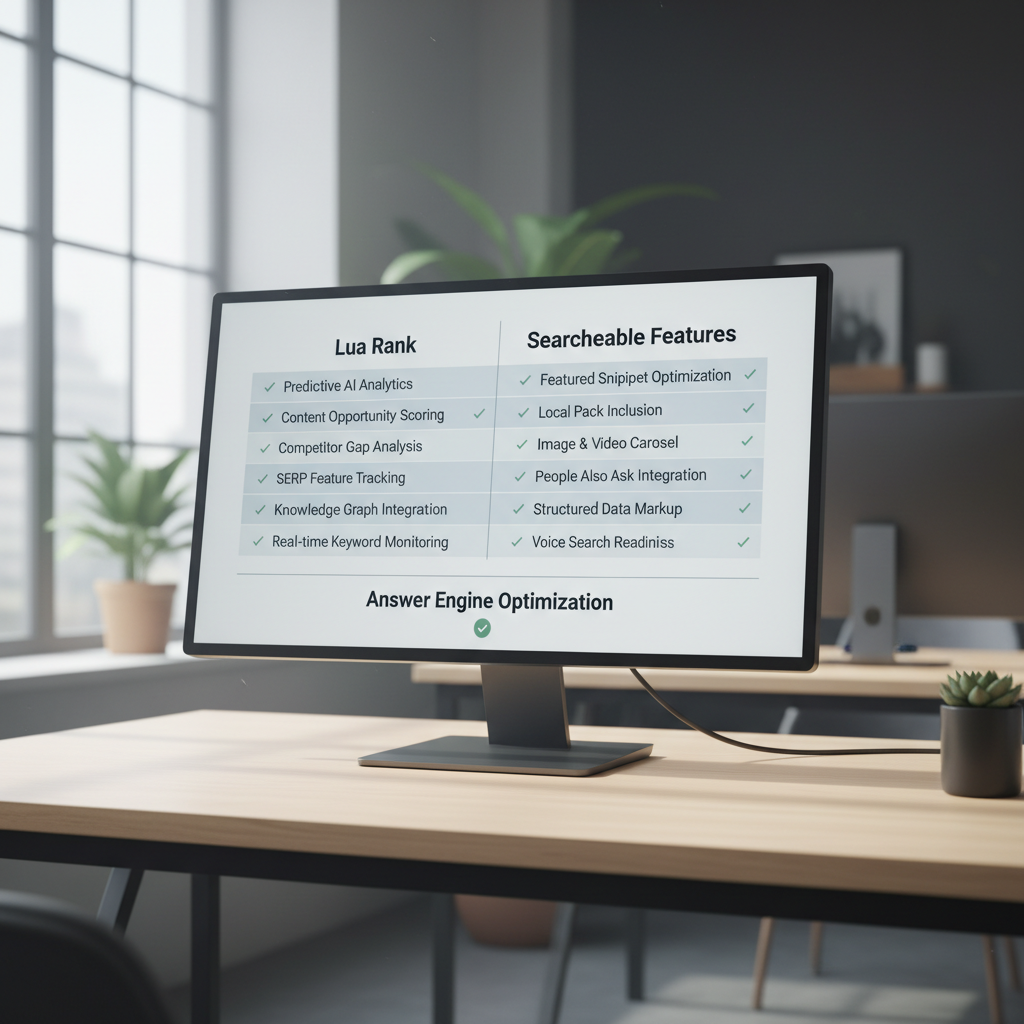
AI search is no longer a future consideration. ChatGPT handles over a billion queries per week. Perplexity is growing at a pace that has traditional search incumbents paying attention. Google's AI Overviews now appear on a significant share of informational queries globally. If your brand isn't showing up in these answers, you're invisible to a growing segment of high-intent searchers, and that gap is compounding daily.
The question most marketing teams are asking right now isn't whether to invest in answer engine optimization. It's which platform to use. Two names that come up regularly are Lua Rank and Searcheable. Both position themselves as AEO tools. But their feature sets are meaningfully different, and those differences matter depending on what you actually need to achieve.
This comparison breaks down what each platform offers, where they diverge, and which teams are best served by each.
What Answer Engine Optimization Actually Requires
Before comparing platforms, it's worth being precise about what effective answer engine optimization involves. AEO isn't a single tactic. It's a multi-layered discipline that requires your content to be structured so AI models can extract and cite it, your site's technical foundation to support machine readability, your brand to be mentioned and validated across credible third-party sources, and your visibility to be tracked across multiple AI platforms simultaneously.
Most platforms address one or two of these layers. Very few address all of them. According to McKinsey's research on generative AI's economic potential, businesses that build AI-native capabilities early capture compounding advantages that late movers find difficult to close. That's as true for AI search visibility as it is for any other AI-enabled function.
The implication for platform selection: you need a tool that doesn't just diagnose your situation but gives you a structured path to improving it.
The Diagnosis-Only Problem
A common frustration we hear from marketing teams is that they've paid for an AI ranking or visibility audit, received a detailed report of what's wrong, and then been left entirely on their own to fix it. The audit tells them their schema markup is incomplete, their entity authority is low, their FAQ content isn't optimised for extraction. But it doesn't tell them what to do first, how to do it in their CMS, or what "fixed" looks like for their specific brand and competitive landscape.
This is the core problem with most AEO tools on the market today. They stop at diagnosis.
Lua Rank vs Searcheable: Feature Comparison
Let's get specific. Here's how the two platforms compare across the features that matter most to marketing teams evaluating AI search as a channel.
Feature | Lua Rank | Searcheable |
|---|---|---|
Website optimisation assessment | 13-layer scan | Basic audit |
12-month execution plan | Yes, fully personalised | No |
Day-by-day task scheduling | Yes | No |
Platform-specific CMS instructions | Yes | No |
Automated task execution | Partial (selected tasks) | No |
Multi-model visibility tracking | ChatGPT, Perplexity, Google AI Overviews, Claude | Limited |
Competitor benchmarking | Yes | Basic |
Content and code generation | Yes, exact implementation assets | No |
Approximate monthly cost | Fraction of agency retainer | Varies |
Depth of Website Assessment
Lua Rank scans your website across 13 optimisation layers, covering everything from schema markup and entity structure to content formatting, citation signals, and crawlability by AI models. Searcheable offers an audit function, but it's shallower in scope. For teams that want to understand exactly where they stand before committing to a programme, the depth of the initial assessment matters significantly.
Execution Support
This is where the platforms diverge most sharply. Searcheable surfaces findings. Lua Rank builds a complete 12-month AI visibility programme around those findings, then schedules every task day by day with exact content and code to implement. You're not left interpreting a report. You're working from a programme that tells you what to do on a given day and how to do it in your specific CMS.
For a head of marketing managing a team of two or three people, that difference in execution support is the difference between a tool they'll actually use and one that collects dust after the initial audit.
Multi-Model Visibility Tracking
Tracking AI ranking across ChatGPT, Perplexity, Google AI Overviews, and Claude simultaneously is a non-trivial technical challenge. Most tools track one or two models. Lua Rank tracks all four, and benchmarks your visibility against competitors within the same interface. Global search advertising data from Statista shows how rapidly AI-influenced search is reshaping where intent gets captured. Tracking visibility across only one model gives you an incomplete picture of that shift.
The Counterargument: When Searcheable Might Be Enough
We believe Lua Rank is the stronger platform for most marketing teams evaluating this space seriously. But that doesn't mean Searcheable is without merit, and we'd rather give you a straight assessment than a one-sided pitch.
If your team already has strong in-house AEO expertise and primarily needs a lightweight monitoring tool to track AI mentions and flag issues as they emerge, a simpler platform may be sufficient. Searcheable's lower complexity can appeal to teams that want basic visibility software without committing to a structured programme.
There's also a valid argument that some businesses aren't yet at the stage where a full 12-month programme is appropriate. If you're in the early information-gathering phase, a lightweight audit tool might be a reasonable starting point before graduating to a full programme like Lua Rank.
That said, HBR's analysis of how generative AI is disrupting knowledge work makes clear that the window for building early advantages in AI-native channels is closing. The teams treating AEO as a "we'll get to it next quarter" project are ceding ground that becomes harder to reclaim.
The Agency Replacement Angle
One context that's worth naming directly: many teams evaluating these platforms have already priced up a GEO agency retainer and found it difficult to justify. Retainers in this space typically run from $5,000 to $10,000 per month. Lua Rank delivers a structured, personalised programme at well under 10% of that cost. That's not a minor difference in pricing. It's a fundamentally different category of investment, accessible to mid-market teams that wouldn't otherwise have a path into this channel.
If you want to explore what that looks like for your brand, Lua Rank's platform gives you a clear entry point without the agency overhead.
Looking Forward: Where AEO Features Are Heading
The platforms that will matter most in 12 to 18 months won't just track AI visibility. They'll integrate directly with publishing workflows, auto-generate schema at scale, and adapt optimisation recommendations as AI model behaviours change. We're already building toward that. Expect the gap between diagnostic-only tools and full-programme platforms to widen as the channel matures and brands demand measurable outcomes rather than reports.
The teams that invest in structured, executable programmes now will have 12 months of compounding visibility by the time the rest of the market catches up.
Frequently Asked Questions
What is the difference between AEO and traditional SEO?
Traditional SEO optimises your content to rank in blue-link search results. Answer engine optimization focuses on getting your content cited by AI models like ChatGPT, Perplexity, and Google's AI Overviews when they generate responses to user queries. The underlying signals overlap to a degree (authority, content quality, technical structure) but AEO places much greater weight on how clearly your content is structured for machine extraction, how your brand is validated across third-party sources, and how precisely your content answers specific questions. The two disciplines are complementary, but they require different tactics and different tracking infrastructure.
How long does it take to see results from answer engine optimization?
It depends on your starting point and competitive landscape, but it's faster than most teams expect. Lua Rank has delivered first-page ChatGPT rankings for clients in under 40 days. The fastest gains typically come from technical fixes (schema, structured data, content formatting for extraction) that AI models respond to quickly. Authority and citation signals take longer to build but have a longer-lasting effect. A structured 12-month programme addresses both the quick wins and the foundations that compound over time.
Do I need a dedicated technical team to implement an AEO programme?
Not with the right platform. Lua Rank is built specifically for marketing teams, not developers. It provides platform-specific CMS instructions so that whoever handles your website (whether that's an in-house marketer, a freelancer, or an agency) can implement tasks without needing to interpret technical jargon. Some tasks are executed automatically by the platform. For the rest, you get the exact content and code to use. The realistic time commitment is 3 to 5 hours per week, which puts the programme within reach of any marketing team with at least one person focused on this channel.
Related articles

Cited Newsletter Issue 14 (May 5th 2026)
Cited newsletter 5 May 2026: ChatGPT brand citations rise, Perplexity weights recency harder, and Google AI Overviews expand internationally.
Louis Lua
Cited Newsletter Issue 9 (April 27th 2026)
Cited newsletter 27 Apr 2026: ChatGPT citation shifts, Perplexity source rotation, and Google AI Overviews trends — with actionable steps for marketers.
Louis Lua