ChatGPT vs Traditional Search: Where Discovery Is Heading
 Louis LuaAI Visibility Analyst at Lua Rank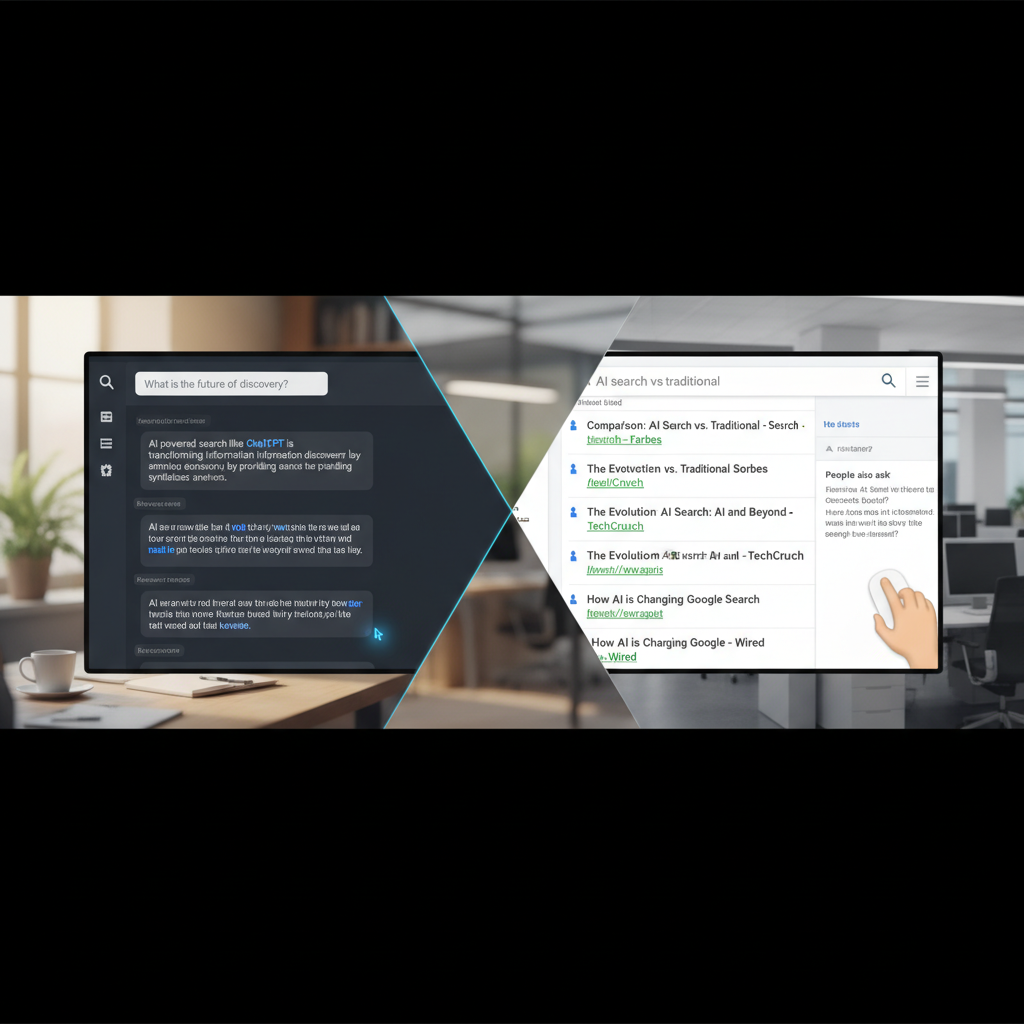
AI search vs traditional search isn't a subtle shift — it's a different discovery model entirely. Here's what it means for your visibility strategy.

Something meaningful is happening to how people find information online. It is not replacing traditional search overnight, but the direction is clear enough that waiting to pay attention is a real competitive risk. AI search is not a feature update to Google. It is a different model of discovery entirely, and businesses that treat it that way are already pulling ahead.
Here is where things actually stand, and what it means for your visibility.
How AI Search and Traditional Search Actually Differ
Traditional search works on a retrieval model. You type a query, an algorithm ranks pages by relevance and authority, and you get a list of links. You click, you skim, you decide. The user does the synthesis work.
AI search inverts that. When someone asks ChatGPT, Perplexity, or Claude a question, the model synthesises an answer from multiple sources and presents it as a direct response. No list of ten blue links. No clicking through to compare. One answer, sometimes with citations, sometimes without.
This changes everything about how discovery works for brands. In traditional search, ranking on page one gives you a shot at a click. In AI search, being cited in the answer is the exposure. If the model does not know your brand exists, or does not trust your content enough to reference it, you are invisible to that user entirely.
The Mechanics Behind Each Model
Traditional search engines crawl and index pages, then rank them using hundreds of signals: backlinks, on-page relevance, technical performance, user behaviour. Global search advertising spend reflects how commercially embedded this model has become, with billions flowing through it annually.
AI models work differently. They are trained on large corpora of text and learn which sources are authoritative, consistent, and well-structured. At inference time (when a user asks a question), retrieval-augmented models pull in live data from crawled sources. What determines citation is a combination of training weight, content structure, entity clarity, and how well your content answers questions in a format the model can extract cleanly.
The optimisation levers are different too. Keyword density barely matters. Schema markup, clear entity definitions, consistent brand signals across the web, and genuinely authoritative long-form content matter a great deal.
A Comparison Worth Looking At
Factor | Traditional Search (Google) | AI Search (ChatGPT, Perplexity, Claude) |
|---|---|---|
Output format | Ranked list of links | Synthesised answer with optional citations |
User journey | Click, read, decide | Read answer, sometimes follow citation |
Key ranking signals | Backlinks, keywords, technical SEO | Authority, entity clarity, content structure |
Optimisation approach | On-page SEO, link building | GEO/AEO: structured content, brand signals |
Visibility measurement | Rankings, impressions, clicks | Citation frequency, answer inclusion rate |
The Discovery Shift Is Real, But Not Total
A fair counterargument: traditional search still handles billions of queries every day. Google is not going anywhere. For many query types, especially local, transactional, and navigational searches, the classic search model remains the dominant path to discovery.
That is true. The discovery shift is not a binary switch. It is a gradual migration of certain query types, particularly research-oriented and comparison queries, toward AI-driven responses. Someone deciding which accounting software to use for their business is increasingly likely to ask ChatGPT first. Someone looking for a restaurant near them is not.
The economic potential of generative AI across industries, as documented by McKinsey, points to a fundamental shift in how knowledge work gets done, including how decisions are researched. That migration is happening in the exact query category where most B2B and considered-purchase brands want visibility.
Ignoring AI search because traditional search still works is like ignoring mobile optimisation in 2013 because desktop traffic was still larger. Technically correct in the moment. Wrong as a strategy.
Where ChatGPT Is Winning Right Now
ChatGPT's dominance is clearest in a few specific use cases:
Research and comparison queries: "What is the best project management tool for a team of 20?" This is exactly the kind of question where AI answers are replacing multi-tab Google sessions.
Explanation and education: Complex topics where users want synthesis, not links to read.
Decision support: Buyers at the consideration stage using AI to shortlist options before talking to sales.
International markets: Adoption of AI search tools is genuinely global, with strong usage across Europe, Asia-Pacific, and Latin America, not concentrated in one region.
If your business relies on being discoverable during the research phase of a buying decision, this is where you need to pay attention.
What This Means for Your Visibility Strategy
The practical implication of the AI search vs traditional divide is that visibility now requires two distinct programmes. Your existing SEO work still matters. But it does not translate automatically into AI visibility. A site that ranks well on Google can be completely absent from ChatGPT answers on the same topic.
We have seen this repeatedly across the brands using Lua. Strong Google rankings do not predict AI citation. The signals are different enough that you genuinely need a separate optimisation layer. That includes structured content that AI models can extract cleanly, clear entity definitions so models understand what your brand does and for whom, consistent brand signals across third-party sources, and a content architecture that mirrors how AI models retrieve and synthesise information.
The window for early mover advantage is open right now, but it is not permanently open. As Harvard Business Review has noted, generative AI is reshaping creative and knowledge work faster than most organisations are adapting. The brands building AI visibility today are doing so before their categories get saturated. In 18 months, the effort required to break into established AI answer patterns will be significantly higher.
The Search Evolution Is Not Waiting for Consensus
The honest prediction: within three years, AI-generated answers will be the primary format for a significant proportion of informational and research queries globally. Google's own AI Overviews are already shifting click behaviour on its platform. Perplexity is growing fast. ChatGPT's search integration is getting more sophisticated with each release.
Traditional SEO will remain valuable, but it will sit alongside AI visibility as a parallel requirement, not as a proxy for it. Marketing teams that build both capabilities now will hold structural advantages that are genuinely hard to replicate later.
The search evolution does not require you to abandon what works. It requires you to extend your visibility programme into the channels where discovery is already moving.
Conclusion
The difference between AI search and traditional search is not cosmetic. It is a fundamentally different model of how users find and evaluate information, and it responds to different signals. Businesses that recognise this early and build visibility across both channels are not gambling on a trend. They are making a practical bet on where their buyers are already going.
The tools to act on this exist now. The question is whether you move before your competitors do.
Frequently Asked Questions
Does strong Google SEO automatically transfer to AI search visibility?
No, and this surprises a lot of marketing teams. Traditional SEO signals like backlink profiles and keyword optimisation do not map cleanly onto how AI models select and cite sources. You can rank on page one of Google for a term and be entirely absent from ChatGPT or Perplexity answers on the same topic. AI visibility requires its own optimisation layer, focused on content structure, entity clarity, and brand authority signals that models can recognise and trust.
Which businesses should prioritise AI search visibility right now?
The clearest priority is for businesses where buyers research before purchasing. B2B software, professional services, financial products, health and wellness, and considered consumer purchases all fit this profile. If your customers are likely to ask an AI model "what is the best option for X" before making a decision, you need to be in those answers. Businesses that rely purely on transactional or local queries have less urgency, though the landscape is shifting even there.
How long does it take to see results from AI visibility optimisation?
Results vary by competitive category and how consistently the work gets done, but the timeline is shorter than many people expect. We have seen brands achieve first-page ChatGPT rankings in under 40 days when following a structured programme. The key is that AI models update their knowledge and citation patterns regularly, so improvements in content quality and brand signals can surface relatively quickly compared to the slow crawl of traditional link-building campaigns.