Is Your Website Built for AI Search? Get Your Score in Minutes
 Guilherme HortinhaCo-Founder of Lua Rank & AI Visibility Strategist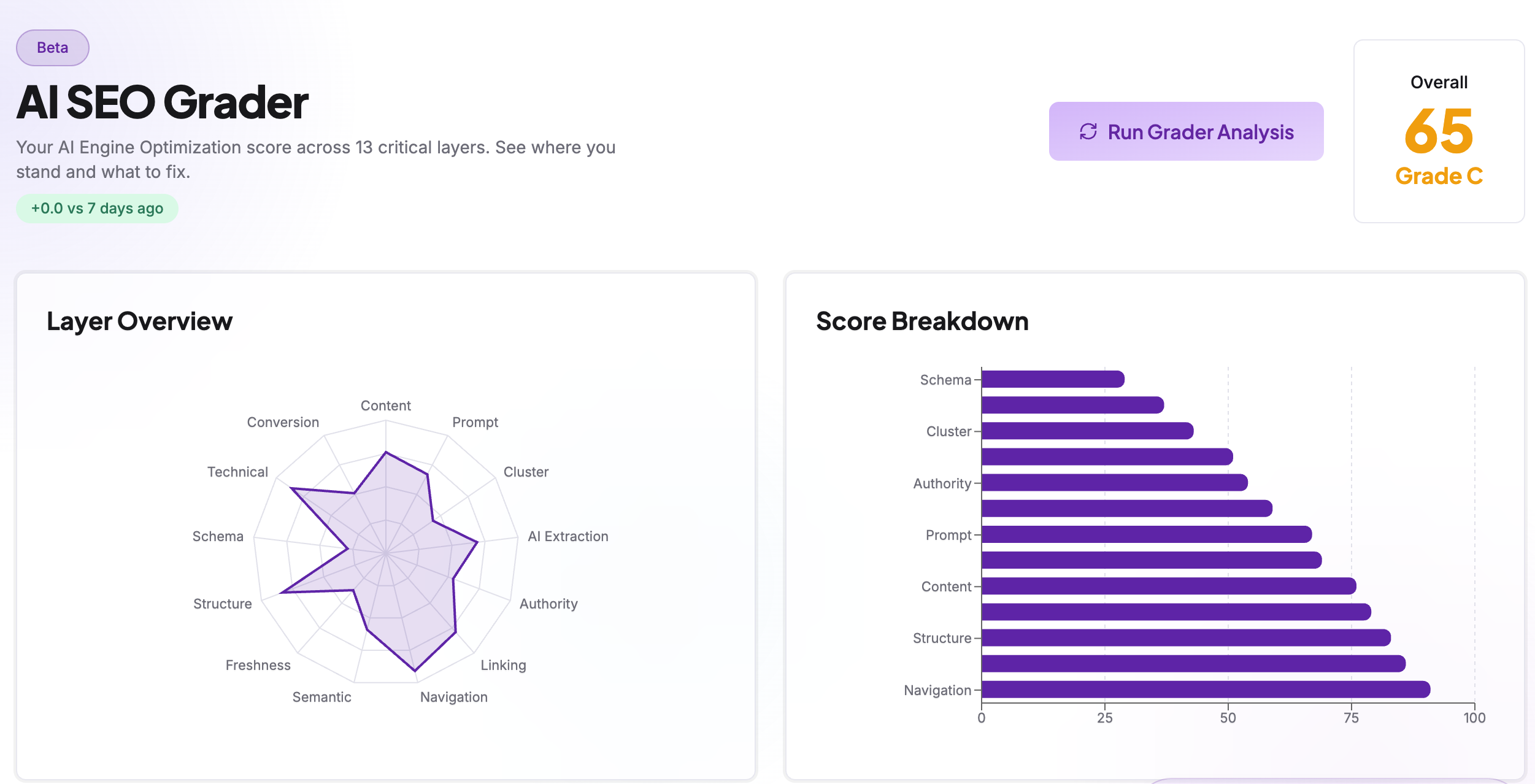
Test your website's AI search readiness with our AI SEO grader. Get your GEO score across 13 visibility factors in minutes and optimize for AI engines.
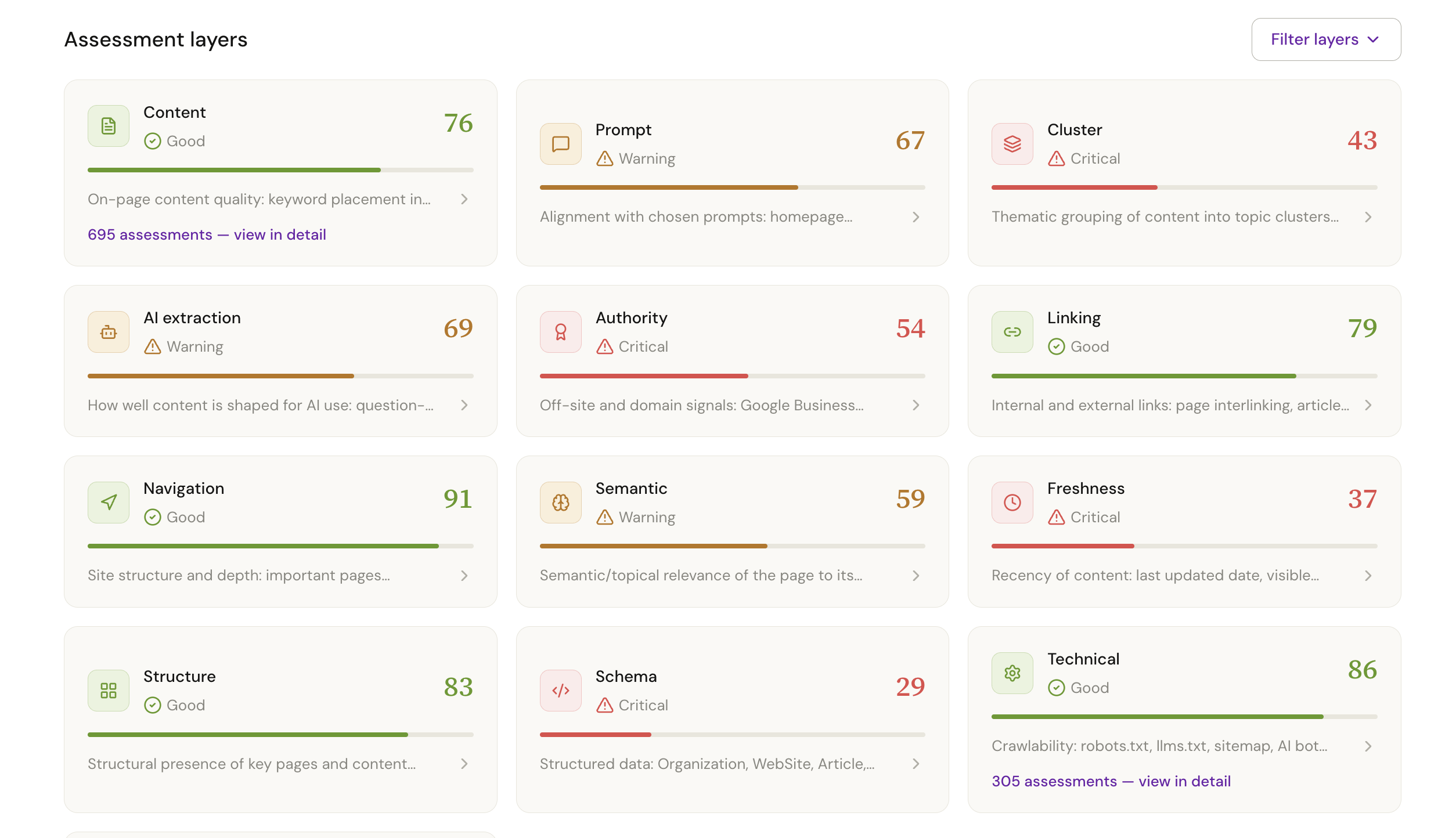
Lua's GEO Score evaluates your website across 13 AI visibility factors to show how well-optimized it is for AI search engines like ChatGPT, Gemini, and Perplexity.
While traditional SEO tools measure Google rankings, AI search engines work differently. They need structured content, clear semantic signals, and authoritative sources to understand and cite your website.
Our comprehensive assessment reveals exactly where you stand compared to competitors and what specific improvements will make the biggest difference for your AI visibility.
Are You Invisible to AI Search Engines?
Most businesses have no way of knowing whether their website is set up to be found, understood, and cited by AI search engines. Traditional SEO tools don't measure this because AI visibility grader requirements are fundamentally different from standard search optimization.
When ChatGPT or Perplexity can't understand your content structure or lacks confidence in your authority signals, you simply don't exist in their responses. According to McKinsey research on generative AI adoption, businesses are rapidly shifting toward AI-powered search, making this gap increasingly costly.
You need an ai seo grader that measures what actually matters for these new systems. Lua Rank built the GEO Score specifically to fill this measurement gap.
How Your GEO Score Works in 3 Steps
Step 1: Site Analysis Enter your website URL and up to three competitor URLs. Lua scans each site across 13 optimization layers including content structure, schema markup, authority signals, semantic clarity, and technical accessibility.
Step 2: Score Dashboard Review your GEO Score dashboard with an overall score out of 100, plus individual layer scores, shown side-by-side against your competitors. Each layer is color-coded so you can instantly see where you lead and where you're behind.
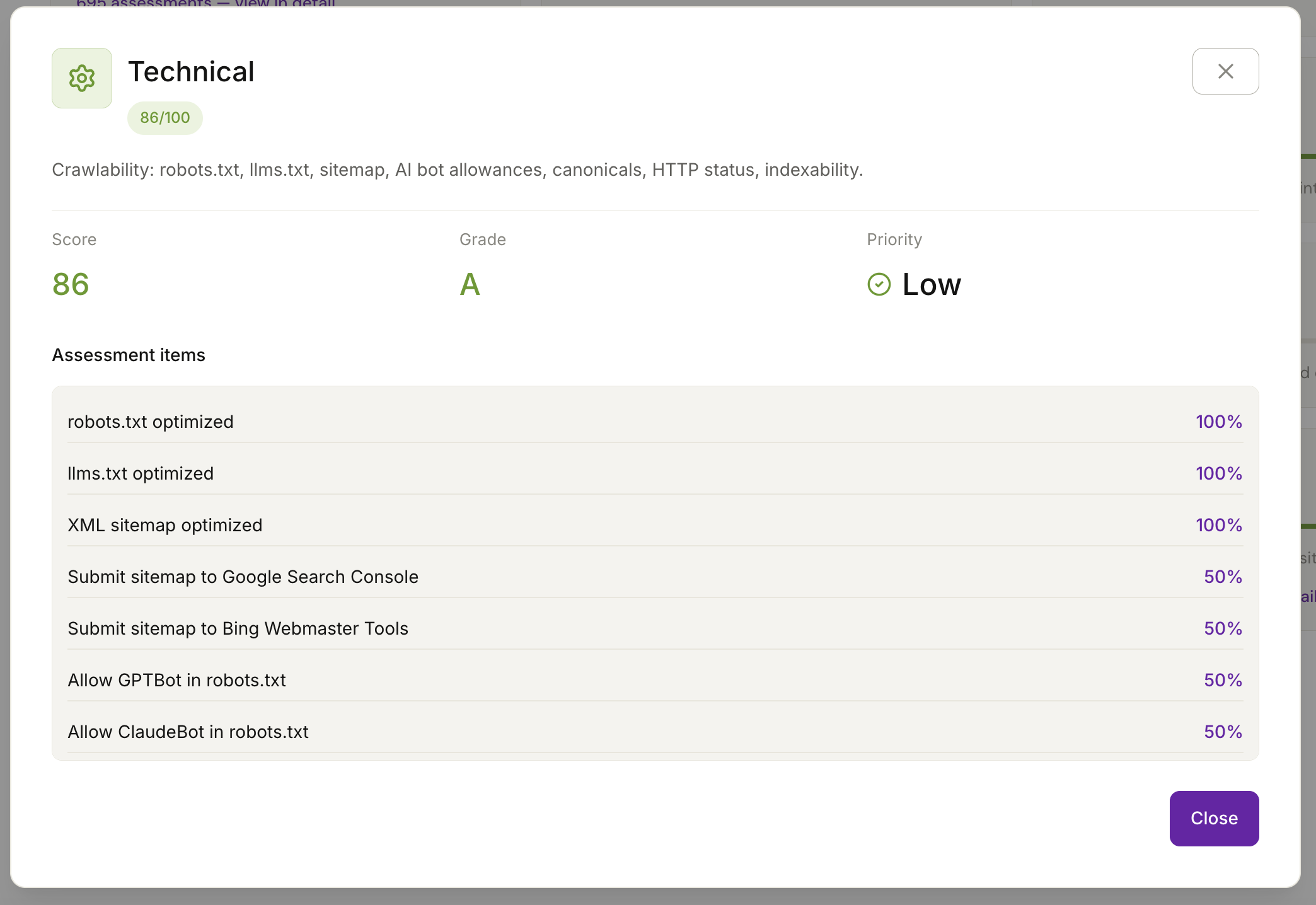
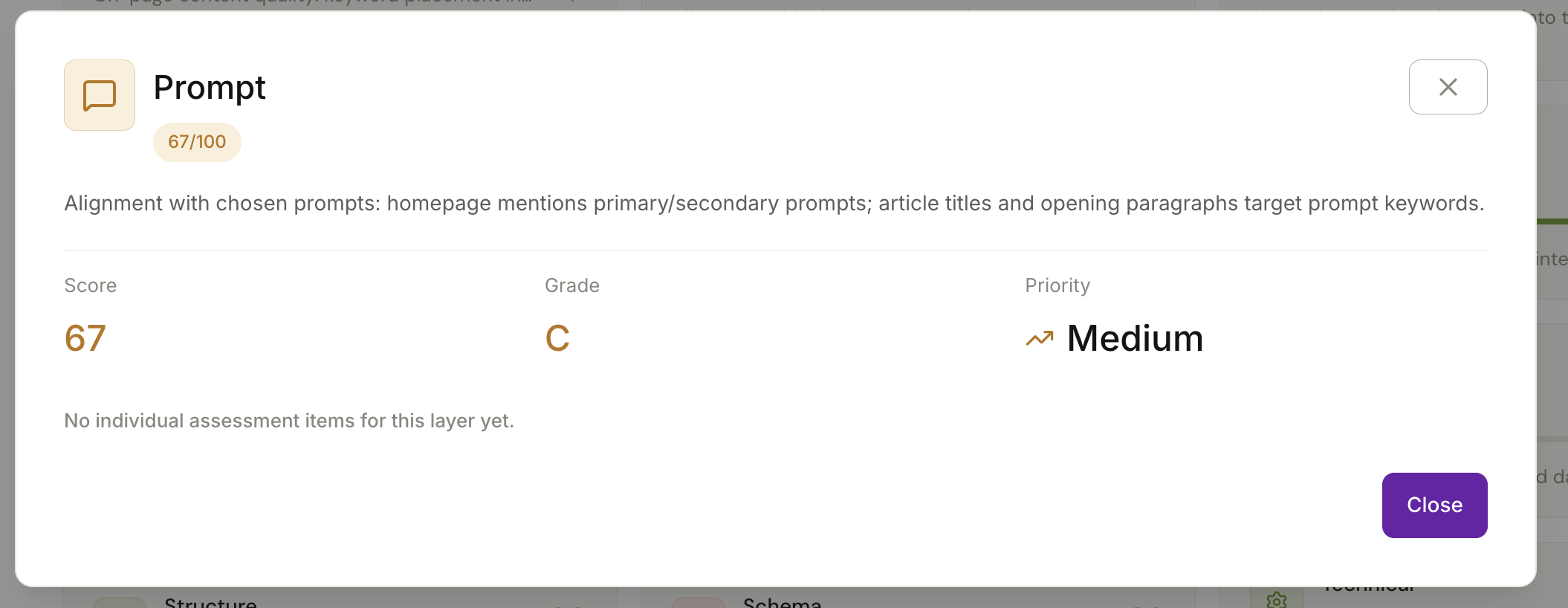
Step 3: Action Plan Drill into any layer to see specific findings and recommendations. Each layer breakdown shows what's working, what's missing, and what to prioritize, giving you a clear action path from score to strategy.
The complete assessment delivers a comprehensive roadmap showing exactly which improvements will have the biggest impact on your AI search visibility. You'll understand not just your current position, but the specific steps to improve it.
Why Your GEO Score Matters
The GEO Score turns "we should probably do something about AI search" into a specific, measurable starting point. It reveals exactly which areas of your web presence need attention, lets you benchmark against competitors with real data, and gives you a baseline to track improvement over time.
Unlike traditional SEO metrics that focus on keyword rankings, a generative engine optimisation grader measures whether AI systems can actually understand and trust your content enough to cite it. Recent data shows AI search adoption accelerating rapidly, making this optimization critical for maintaining digital visibility.
AI search engines prioritize structured, authoritative content with clear semantic signals over keyword-optimized pages that lack context or credibility. A high GEO Score indicates your website provides the foundation these systems need to confidently include you in their responses.
The difference between guessing and knowing your AI readiness becomes your competitive advantage as more searchers turn to AI-powered tools for answers.
What to Keep in Mind
The GEO Score measures optimization readiness (inputs), not actual AI search appearances (outcomes). Think of it as a health check where a high score means your foundations are strong, which is a leading indicator of future visibility. For tracking actual citations and mentions, our AI Visibility Score measures real-time appearances.
Scores are recalculated periodically, so allow time for recent website changes to be reflected. The score represents a snapshot of your current state, so treat it as a diagnostic baseline rather than a one-time grade.
Focus on the layer-by-layer breakdown rather than just the overall number. The specific recommendations within each optimization layer provide your actual roadmap for improvement.
Common Questions
How accurate is an AI SEO grader compared to traditional SEO tools?
Traditional SEO tools measure Google-specific ranking factors like backlinks and keyword density. Our geo grader specifically evaluates the 13 factors that AI search engines prioritize: content structure, semantic clarity, schema markup, and authority signals. These are fundamentally different measurement criteria because AI systems need to understand and trust content before citing it, not just rank it.
How often should I check my GEO Score?
Check your baseline score initially, then quarterly or after major website updates. Since the score measures structural optimization rather than daily performance metrics, it changes more slowly than traditional analytics. Focus on implementing the layer-specific recommendations between assessments for meaningful improvement.
What makes this different from other AI content tools?
Most AI tools help create content, but they don't measure whether that content is actually optimized for AI discovery. Our assessment focuses entirely on how well AI search engines can find, understand, and cite your existing content. You can explore more about our comprehensive approach to AI tools with smart SEO optimization to see how measurement and creation work together.
Can I improve my score without technical expertise?
Many GEO Score improvements involve content structure and clarity rather than complex technical changes. The assessment breaks down recommendations by difficulty level, so you can prioritize high-impact changes that don't require developer resources. Content strategy adjustments often deliver significant score improvements before technical modifications become necessary.
Related articles

How Lua Rank Powers SEO Content at Scale
Lua Rank service turns AI search visibility into a structured 12-month programme — so your team always knows what to build next.
 Louis Lua
Why Teams Switch From Copy.ai to Lua Rank
Lua Rank alternative to Copy.ai: get AI visibility across ChatGPT and Perplexity with a structured 12-month programme at under 10% of agency cost.
Louis Lua
Lua Rank Achieves First-Page ChatGPT Rankings
Lua Rank delivers first-page ChatGPT rankings in under 40 days through structured AI visibility programmes built for real marketing teams.
Louis Lua
Lua Rank's AI Optimization Features Explained
Lua Rank features explained: 13-layer AI assessments, a 12-month execution calendar, and multi-model visibility tracking across ChatGPT, Perplexity, and Google AI Overviews.
Louis Lua