Lua Rank vs Agency Benchmarking: Which Metrics Count
 Louis LuaAI Visibility Analyst at Lua Rank
AI metrics benchmarking done right: see which signals actually predict citation frequency in ChatGPT and Perplexity versus what agencies report.
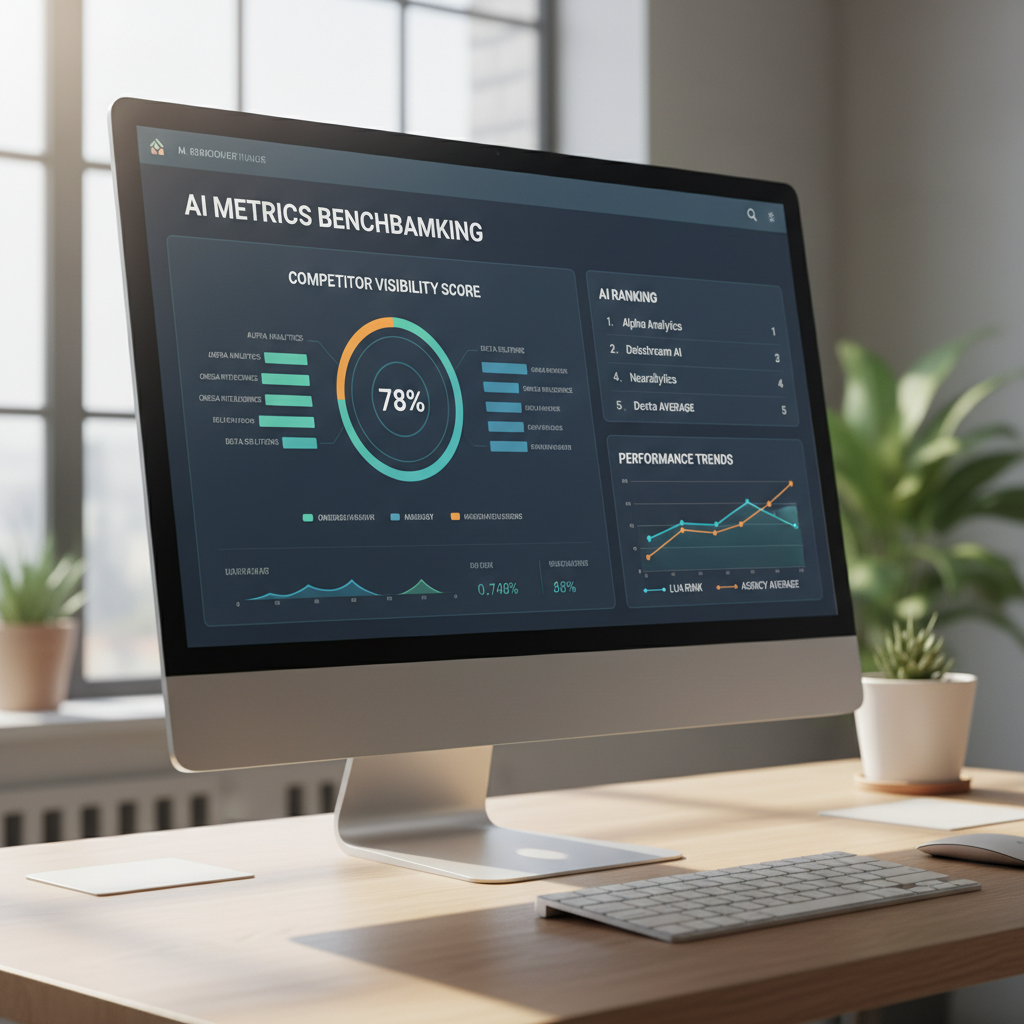
When marketing teams start evaluating their AI search presence, one question surfaces quickly: are we measuring the right things? The metrics that agencies use to justify their retainers are not always the metrics that tell you whether your brand is actually getting cited by ChatGPT, Perplexity, or Google AI Overviews.
This matters more than it sounds. McKinsey's research on generative AI's economic potential makes clear that AI-driven search is reshaping how people discover and evaluate products. If you're benchmarking the wrong signals, you can spend six months optimising for nothing measurable while your competitors quietly build citation authority.
Here's how we think about the difference between what agencies typically report and what actually predicts AI visibility.
What Most Agencies Measure (and Why It Falls Short)
A traditional GEO or AEO agency will often hand you a dashboard full of metrics that look impressive. You'll get domain authority scores, keyword ranking positions in traditional search, share-of-voice estimates, and sometimes a handful of manual spot-checks of whether your brand appeared in a specific ChatGPT response last Tuesday.
The problem isn't that these metrics are useless. It's that they're incomplete, and at $5,000–$10,000 a month, incomplete is expensive.
Vanity Metrics vs Signal Metrics
There's a real distinction between vanity metrics (things that look good in a report) and signal metrics (things that actually correlate with AI citation frequency). Most agency reporting leans heavily on the former.
Domain authority correlates loosely with AI citation likelihood but doesn't explain why one brand gets cited over another in a specific query context
Traditional keyword rankings don't transfer directly to AI model outputs, which synthesise across sources rather than rank them in order
Share-of-voice estimates are often based on sampled queries and don't reflect the breadth of conversational queries where your brand could (or should) appear
Manual spot-checks are not reproducible benchmarks. They tell you about one moment, not a trend
The Accountability Gap
Agencies also tend to conflate activity with progress. You get a report listing deliverables completed (X blog posts published, Y schema tags added) without a clear line between those activities and measurable changes in AI visibility. That's not benchmarking. That's billing documentation.
The Metrics That Actually Drive AI Visibility Benchmarking
Effective AI metrics benchmarking needs to do three things: measure your current visibility state across the AI models that matter, track change over time against a consistent baseline, and compare your position against competitors in your specific query landscape.
At Lua Rank, we assess brands across 13 optimisation layers specifically because no single signal determines AI visibility. The layers cover everything from structured data implementation and content extraction quality to entity clarity and topical authority signals.
The Metrics That Actually Count
Metric | What It Measures | Why It Matters for AI Search |
|---|---|---|
Citation frequency by model | How often your brand appears in AI-generated responses across ChatGPT, Perplexity, Claude, Google AI Overviews | Direct measure of AI visibility, not a proxy |
Query coverage breadth | How many relevant queries in your category trigger a mention of your brand | Reveals whether your visibility is narrow (one topic) or broad |
Content extractability score | How easily AI models can pull structured answers from your pages | Structurally poor pages get skipped even when the content is excellent |
Competitor citation gap | How often competitors appear in queries where you don't | Shows where you're losing ground you haven't claimed yet |
Entity clarity index | How well AI models understand what your brand does, for whom, and in what context | Ambiguous entities get overlooked in favour of well-defined ones |
Optimisation layer completion | Progress against the 13-layer assessment baseline | Tracks execution, not just outcomes |
Competitor Benchmarking That's Actually Comparable
One area where in-house teams using a platform like Lua have a real structural advantage over agency reporting is competitive comparison. When you benchmark competitor visibility through the same query set, the same AI models, and the same scoring methodology you use for yourself, the comparison is genuinely meaningful. Agency competitive reports often compare different data sources, different time windows, or different query sets. The numbers look comparative but they're not.
The global shift in search advertising spend toward AI-mediated channels makes this competitive clarity increasingly valuable. Brands that know exactly where competitors have citation presence (and where they don't) can prioritise execution intelligently rather than guessing.
Agency vs Platform: An Honest Comparison
We're not going to pretend agencies offer nothing. An experienced GEO agency brings strategic thinking, specialist writers, and execution capacity that a lean marketing team genuinely may not have. If you have a large brand with complex content architecture and a budget to match, an agency relationship can make sense.
But for most mid-market marketing teams, the agency vs in-house calculation looks like this:
Dimension | Traditional Agency | Lua Rank Platform |
|---|---|---|
Monthly cost | $5,000–$10,000+ | Fraction of agency cost |
Visibility assessment | Variable, often manual | 13-layer automated scan |
Execution plan | Strategy deck, quarterly reviews | 12-month plan, day-by-day task calendar |
Benchmarking methodology | Often inconsistent across reports | Consistent baseline across all models and competitors |
Content and code delivery | Delivered by agency team | Platform provides exact copy and implementation instructions |
Time to first results | Typically 3–6 months | First-page ChatGPT rankings reported in under 40 days |
Progress visibility | Monthly reporting | Continuous tracking dashboard |
The Counterargument Worth Taking Seriously
A genuine limitation of the platform approach is bandwidth. Lua provides the programme, the tasks, the content, and the instructions. But someone on your team still needs to implement. That's typically 3–5 hours a week. If your marketing team is already stretched and has no one who can own that execution, a managed service may be the practical answer regardless of cost.
That said, most marketing directors we work with tell us that 3–5 hours per week is a reasonable commitment when the alternative is paying $7,000 a month with less transparency into what's being done and why.
What the Next 12 Months Will Demand
As Harvard Business Review's analysis of generative AI's disruption potential suggests, the brands that build early positioning in AI-mediated channels are likely to compound that advantage as adoption accelerates. The metrics that matter today (citation frequency, entity clarity, extractability scores) will only become harder to compete on as more brands wake up to AI search.
The teams that start measuring these signals now, against a consistent baseline and against real competitors, will be the ones with actionable data when the channel becomes crowded. Waiting for an agency to tell you what the benchmarks should be is a slower path than building that measurement capability yourself.
Frequently Asked Questions
What makes AI metrics benchmarking different from traditional SEO measurement?
Traditional SEO measurement tracks keyword positions in ranked lists. AI visibility benchmarking measures something different: how frequently and accurately AI models include your brand in synthesised responses to relevant queries. The signals that drive those outcomes (entity clarity, content extractability, structured data, topical authority) overlap partially with SEO but require distinct measurement approaches. You can rank well in traditional search and still be largely invisible in AI-generated responses.
Can a marketing team really run an AI visibility programme without an agency?
Yes, with the right structure. The main things a team needs are a clear assessment of where they stand today, a prioritised execution plan with specific tasks and implementation guidance, and a way to track whether those actions are moving the needle. Lua provides all three. The commitment required is roughly 3–5 hours per week from one person. The work is guided step by step, so you don't need specialist GEO knowledge to execute it effectively.
How do you benchmark AI visibility against competitors fairly?
Fair competitive benchmarking requires that you and your competitors are evaluated on the same query set, through the same AI models, at consistent intervals. This rules out ad hoc checks and agency reports that use different methodologies across clients. Lua's competitor benchmarking tracks citation frequency and query coverage for your brand and your competitors through the same system, so the comparison is genuinely apples-to-apples. You see exactly where you're ahead, where you're behind, and which gaps are worth prioritising.
Related articles

GEO vs AEO: Which Should Your Team Prioritize First?
GEO vs AEO prioritization explained: find out which AI search strategy your marketing team should tackle first and why the sequence matters.
Louis Lua
Scale Your Brand's Blog with Automation
Scale lifestyle brand scaling through intelligent blog automation. Reduce content production time by 70% while increasing output 400%.
Louis Lua