Rank on Google and ChatGPT With Lua Rank
 Louis LuaAI Visibility Analyst at Lua Rank
Dual search ranking means appearing on Google and being cited by ChatGPT. See how Lua Rank builds both simultaneously in 40 days.
Search has split into two lanes. On one side, you have Google, still processing billions of queries every day. On the other, AI models like ChatGPT, Perplexity, and Claude are increasingly becoming the first stop for product research, comparisons, and recommendations. The businesses that will win the next five years are the ones building visibility in both lanes simultaneously.
That is what dual search ranking means in practice: your brand appearing in traditional search results and being cited by AI models when someone asks a relevant question. And right now, most businesses are only working on one of those two.
Why Google Ranking and AI Visibility Are Two Different Problems
It is tempting to assume that strong Google ranking automatically translates into AI visibility. The logic seems reasonable: AI models train on web content, so if Google ranks you highly, surely the models have absorbed your content too.
That is not quite how it works.
AI models select sources based on factors that go beyond traditional SEO signals. They look for structured, extractable answers. They weight content that directly addresses specific questions, uses clear entity relationships, and is formatted in ways that make information easy to parse. A page optimised purely for Google may rank on page one but get completely ignored by ChatGPT when a user asks a directly relevant question.
According to McKinsey's research on generative AI's economic potential, AI-powered tools are transforming how people discover and evaluate products and services. That shift is already happening at the top of the funnel, and businesses that do not account for it in their marketing strategy are quietly losing ground.
What AI Models Actually Look For
When a user asks ChatGPT to recommend a project management tool for a remote team, the model is not running a live Google search. It is drawing on what it has indexed and weighted during training and retrieval. The sources it cites tend to share a few characteristics:
Clear, specific answers to the type of question being asked
Structured content with logical headings and concise paragraphs
Strong entity associations (the brand is clearly connected to a category and use case)
Consistent mentions and citations across multiple reputable sources
Technical foundations that allow crawlers and parsers to extract content cleanly
None of those factors are captured by standard SEO metrics. You can have a domain authority of 70 and still be invisible to AI models for the queries that matter most to your business.
The Gap Most Businesses Are Missing
Most marketing teams are aware that AI visibility is becoming important. Fewer have a structured plan for building it. The tools available until now have mostly been diagnostic: they tell you what is wrong, then leave you to figure out what to do about it. That is not a programme. That is a report.
Lua Rank was built specifically to close that gap. We do not just scan your site and hand you a list of issues. We generate a complete 12-month AI visibility programme, schedule every task day by day, and provide the exact content and code needed to execute it.
How Lua Rank Builds Dual Search Ranking
The Lua approach is structured around a core insight: dual search ranking is not about doing two separate things in parallel. It is about building content and technical foundations that serve both ranking environments simultaneously. Much of what makes a page citable by AI models (clear structure, direct answers, strong entity signals) also happens to improve organic search performance.
The 13-Layer Website Assessment
When a new brand joins Lua, we start with a comprehensive scan across 13 optimisation layers. This covers everything from technical schema implementation and content structure to entity recognition, citation authority, and platform-specific formatting signals. The output is not just a health score. It is a prioritised gap analysis that feeds directly into your execution plan.
Most diagnostic tools stop here. We use it as the starting point.
A 12-Month Execution Plan, Scheduled Day by Day
Based on the assessment, Lua generates a structured programme tailored to your brand, your category, and the AI platforms most relevant to your audience. Tasks are scheduled day by day, with platform-specific instructions for your CMS, the exact content to create or update, and in some cases, automated execution.
This matters because consistency is one of the biggest predictors of AI visibility improvement. The brands that build ChatGPT ranking are not the ones who made a few changes in month one and moved on. They are the ones who systematically built topical authority and citation signals over time, with a plan they could actually follow.
Multi-Model Tracking and Competitor Benchmarking
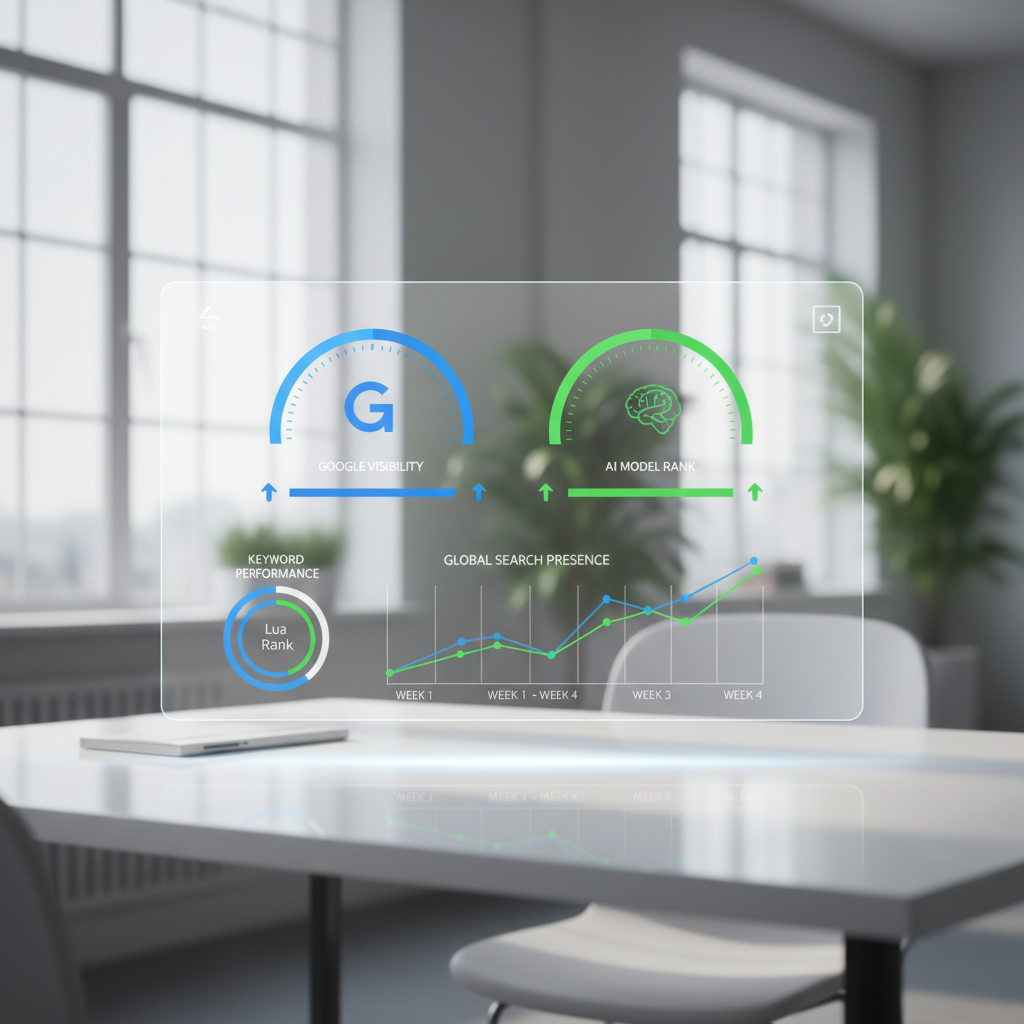
Lua tracks your visibility across ChatGPT, Perplexity, Google AI Overviews, and Claude, not just one model in isolation. We show you how your brand is being cited, what questions are surfacing your content, and how your position is shifting relative to competitors over time.
Platform | Visibility Signal Tracked | Update Frequency |
|---|---|---|
ChatGPT | Citation frequency, query relevance | Weekly |
Perplexity | Source selection, answer inclusion | Weekly |
Google AI Overviews | Feature snippet capture, overview citations | Weekly |
Claude | Brand mention, category association | Bi-weekly |
Is Dual Ranking Actually Worth the Investment?
Fair question. If your current organic traffic is strong and converting well, why add another channel to manage?
A few reasons. Global search advertising spend continues to grow, but the distribution of that search attention is shifting. Users who turn to AI models for recommendations are often further along in their decision process. They are not browsing. They are evaluating. Being cited in that moment is a different kind of visibility than a page-five organic ranking, and in many categories, the competition for AI citations is still remarkably thin.
The counterargument is real: AI search behaviour is still evolving. Models change, retrieval methods shift, and what works today for ChatGPT ranking may need to be updated in six months. That is a genuine risk. Our response is that the underlying foundations we help you build (clear content structure, strong entity associations, citation authority) are durable across model updates. They also happen to improve your Google performance, so the investment has compounding returns regardless of how individual models evolve.
Harvard Business Review's analysis of generative AI disruption points to a recurring pattern: early movers in AI-adjacent channels establish positioning that is difficult and expensive for late entrants to replicate. That dynamic is already playing out in AI search. The brands building visibility now are going to be significantly harder to displace in 12 months.
What Results Look Like in Practice
Across the 40+ brands currently running programmes on Lua, we are seeing first-page ChatGPT rankings achieved in under 40 days for brands that commit to the structured execution plan. That is not a universal guarantee, and results vary by category and competitive density. But it gives a reasonable benchmark for what is achievable when the programme is followed consistently.
Who Gets the Most From Lua
Lua is not the right fit for every business. It works best for marketing teams at established companies (typically 10 to 200 employees) who have at least one person who can dedicate 3 to 5 hours per week to following the programme. If you do not have that capacity, the plan will not execute itself (though Lua automates what it can).
If you do have that capacity, Lua replaces what a specialist GEO agency would charge $5,000 to $10,000 per month to deliver, at a fraction of the cost.
Frequently Asked Questions
What exactly is dual search ranking and why does it matter now?
Dual search ranking refers to building your brand's visibility across both traditional search engines like Google and AI-powered models like ChatGPT, Perplexity, and Claude. It matters now because a growing share of product research and purchase decisions are beginning with AI queries, not keyword searches. Businesses that only optimise for Google are missing an increasingly significant portion of discovery-stage traffic, particularly in B2B and considered purchase categories.
Does improving my Google ranking automatically help my AI visibility?
Partially, but not reliably. Strong Google ranking signals that your content is authoritative, and AI models do weight authority. But the structural and formatting requirements for AI citation are distinct from traditional SEO. Content that ranks well on Google may still be invisible to AI models if it lacks clear entity associations, structured answers, or the technical foundations that allow AI parsers to extract information cleanly. That is why a dedicated AI visibility programme produces materially better results than SEO optimisation alone.
How long does it take to see measurable results with Lua?
Results depend on your starting point, category competitiveness, and how consistently the programme is executed. Among brands currently on Lua, first-page ChatGPT ranking for target queries has been achieved in under 40 days in a number of cases. More broadly, measurable movement in AI visibility scores tends to appear within the first 60 to 90 days for brands that follow the scheduled execution plan. Lua's tracking dashboard shows your progress week by week, so you are never guessing whether the work is having an effect.