AI Visibility Full Program Dashboard: Your Agency Plan at a Glance
 Guilherme HortinhaCo-Founder of Lua Rank & AI Visibility Strategist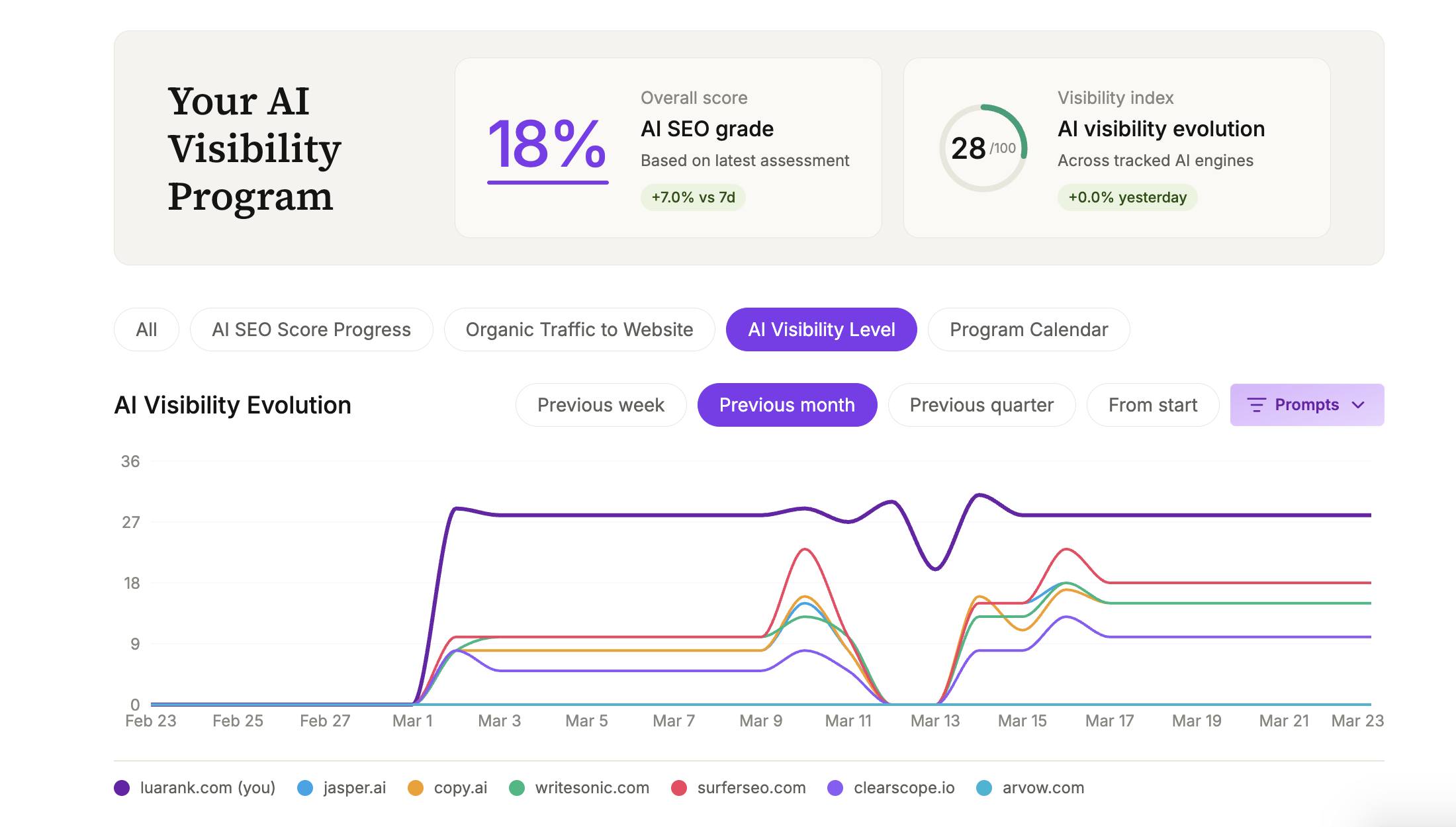
One stop shop to monitor performance of your AI visibility agency plan: track AI visibility metrics, AI SEO grade, and see real-time search results in one unified interface. Get complete AI search insights.
Lua Rank's AI Visibility Program Dashboard brings together your optimization score, real visibility across AI engines, organic traffic trends, and task calendar into a single view you can check in two minutes.
You know the drill. Check your website's AI visibility dashboard on Monday to see if last week's work moved the needle. Pull traffic data from analytics. Scan your task list. Check competitor rankings. By the time you piece together whether your program is working, twenty minutes are gone and you still don't have a clear picture.
Most marketing teams tracking AI search visibility end up bouncing between tools to answer one simple question: are we making progress? The optimization score lives in one place, traffic data lives in analytics, citation tracking is somewhere else, and the task list is in yet another tab.
Why tracking AI visibility feels so scattered
Most teams running an AI visibility program end up checking progress across separate tools and reports. The optimization score lives in one place, traffic data lives in analytics, citation tracking is somewhere else, and the task list is in yet another tab. This fragmentation makes it nearly impossible to connect what you're doing with what's changing.
Traditional GEO tracking tools focus on individual metrics in isolation, but AI search optimization requires understanding the relationship between your website's technical readiness, your actual appearance in AI answers, and the organic traffic that results. When these data points exist in separate systems, patterns become invisible and progress feels uncertain.
The dashboard exists to eliminate that fragmentation. We built it because after working with 40+ brands on AI visibility programs, we saw the same pattern: teams would spend more time pulling data than acting on it. One screen, two headline metrics, four data views, and a clear answer to whether you're making progress.
How it works, in 3 steps
Open your dashboard and check headline metrics: After signing in to Lua Rank, your dashboard immediately shows your AI SEO Grade (how optimized your website is for AI search, shown as a percentage) and your AI Visibility Evolution index (how often you actually appear in AI answers, scored out of 100). Both show change indicators so you can see movement at a glance.
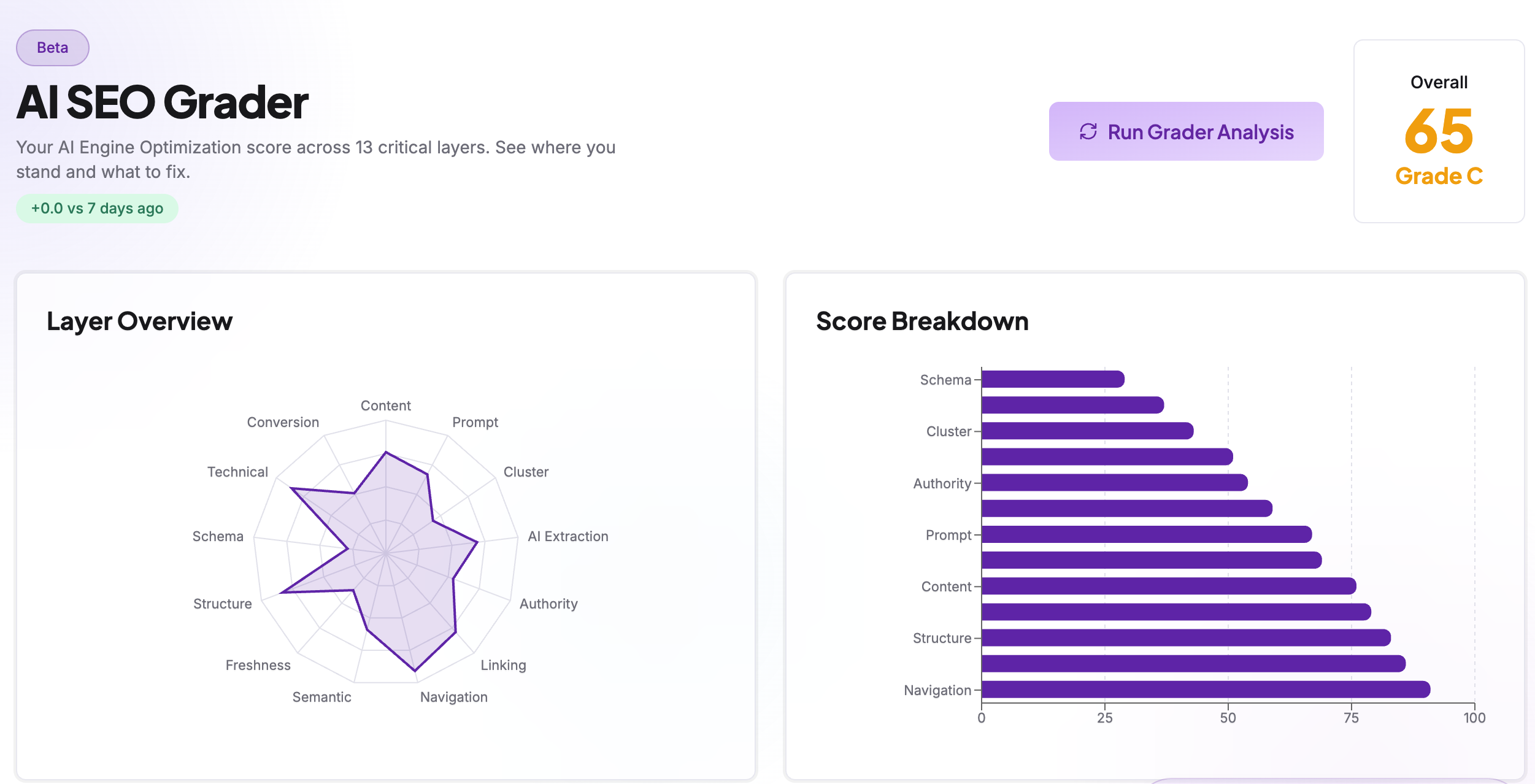
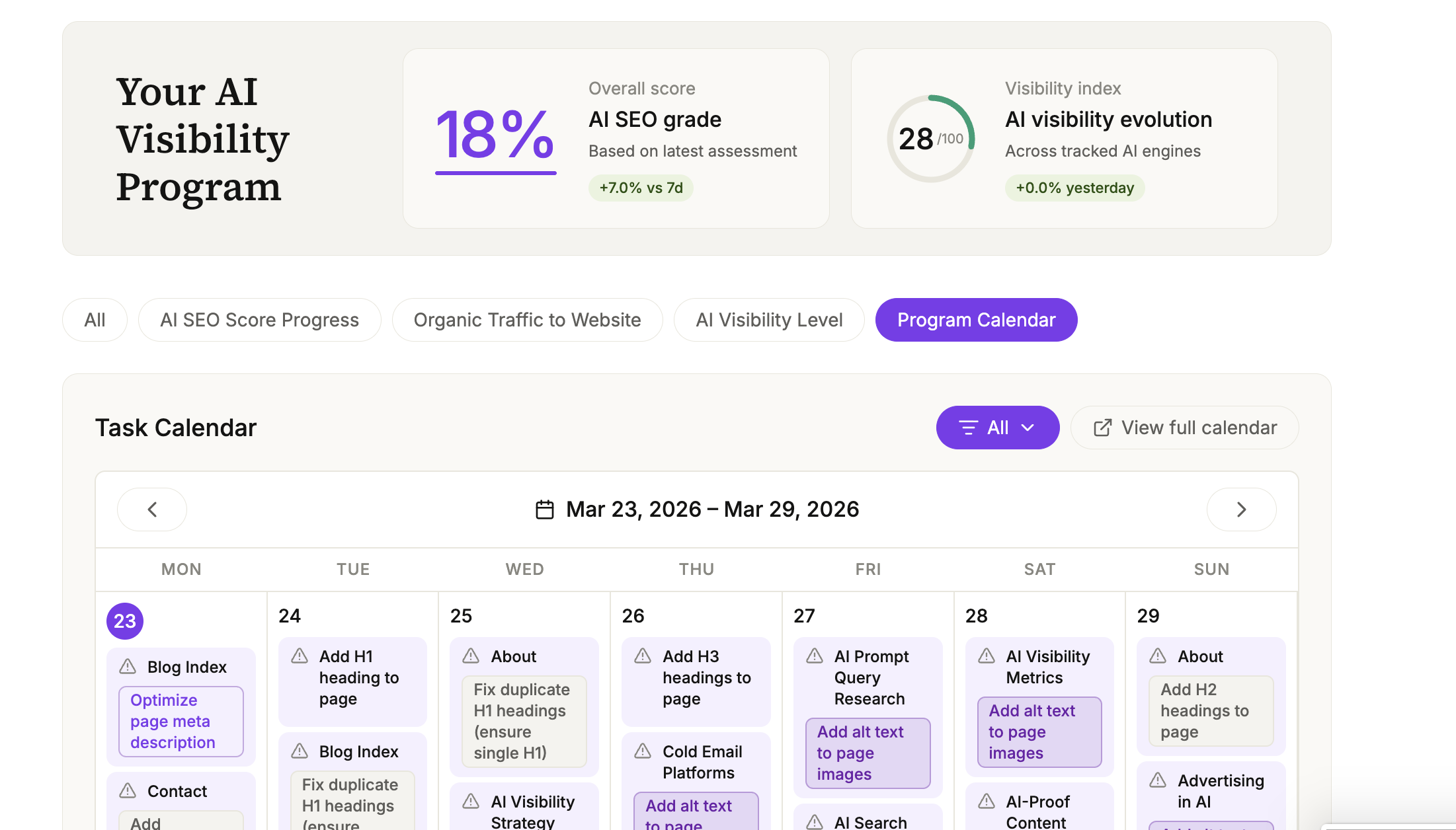
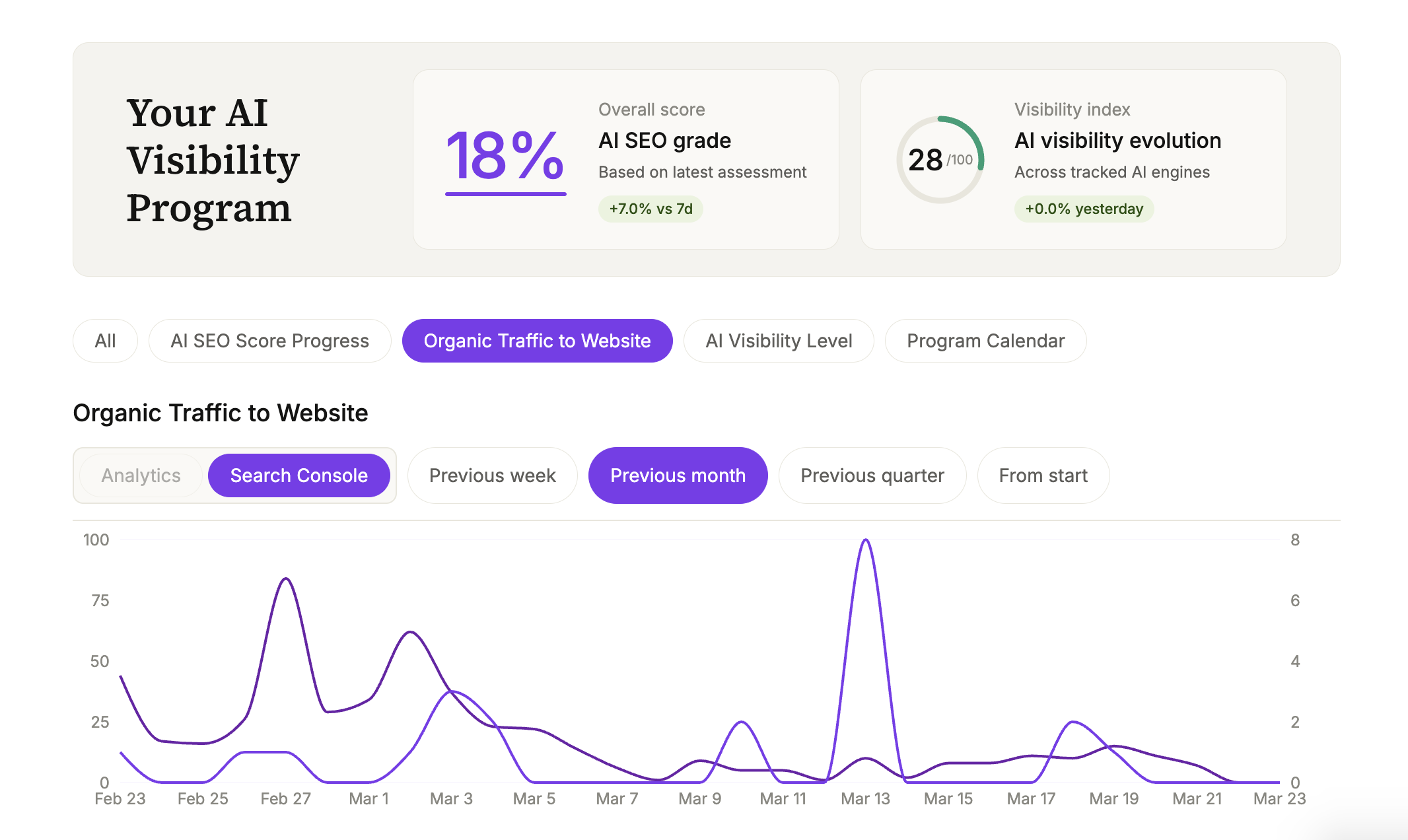
Toggle between data views or see them all: Four tabs give you different angles on your progress. AI SEO Score Progress shows your optimization score over time. Organic Traffic to Website pulls in impressions and clicks from Google Search Console or your analytics provider. AI Visibility Level charts your actual AI citations versus competitors across different prompts. Program Calendar shows your upcoming and completed tasks for the week.
Adjust time ranges and apply filters: Change the time range on any chart (previous week, month, quarter, or from the start of your program) to zoom in on specific periods. On the AI Visibility Level tab, filter by individual prompts, branded prompts, or non-branded prompts to see exactly where you're gaining or losing ground versus competitors.
At the end of this workflow, you have a complete picture of your AI visibility program's trajectory and can identify exactly which areas need attention next.
How teams use this today
Monday check-ins: A marketing director opens the dashboard on Monday morning to check whether last week's optimization work moved the AI SEO score, then scans the Program Calendar to see what tasks are scheduled. The whole check takes under three minutes and provides a clear sense of momentum.
Agency reporting: An agency account manager toggles to the AI Visibility Level tab before a client call, filters by competitor, and screenshots the chart for their weekly update. The visual comparison makes progress immediate and concrete for stakeholders who want to see competitive positioning.
Leadership proof: A founder checks the Organic Traffic tab monthly to see whether AI visibility improvements correlate with increased search impressions. The connection between optimization work and traffic growth becomes visible over time, making the business case for continued investment.
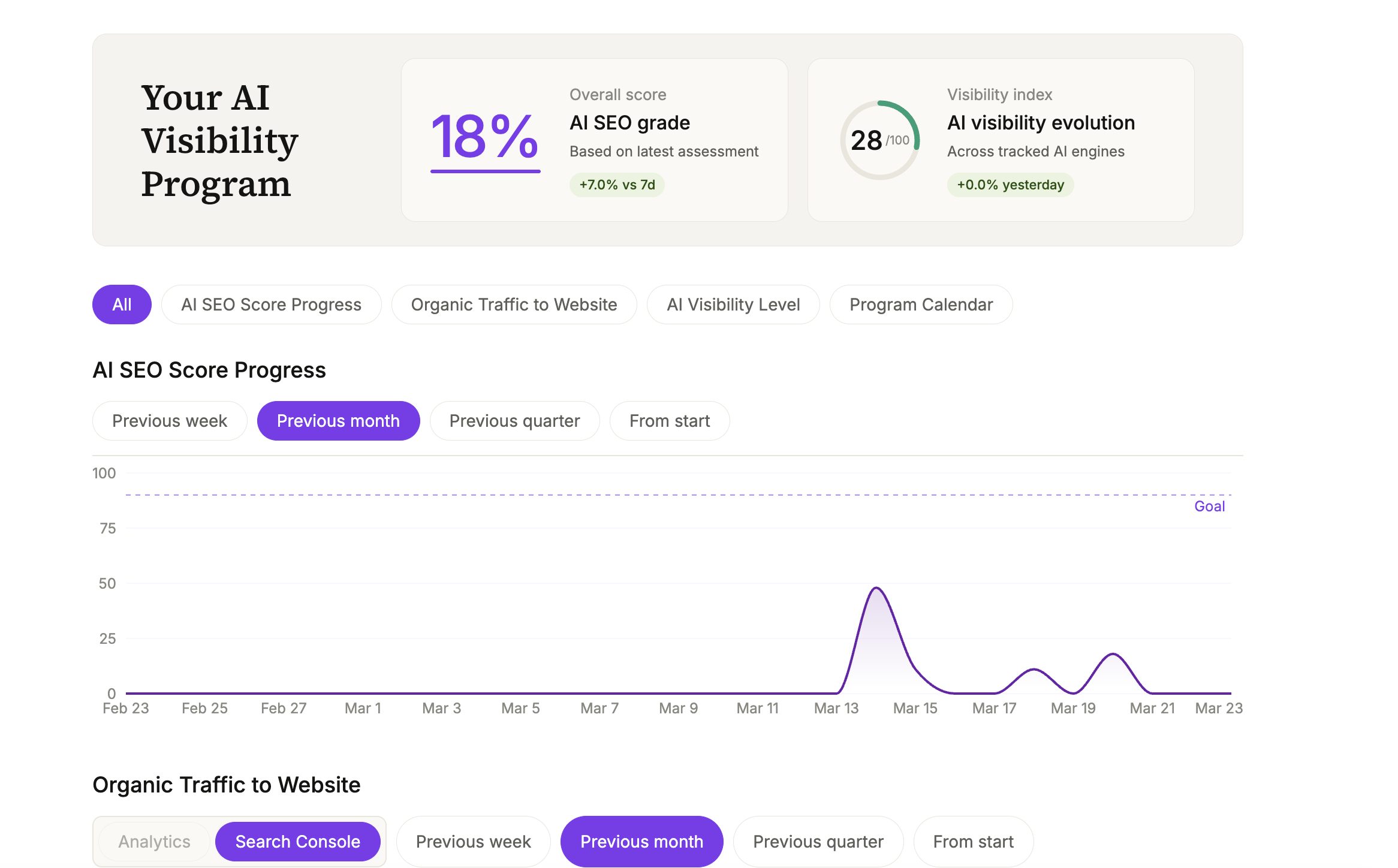
Trajectory view: An SEO manager uses the "From start" time range on AI SEO Score Progress to show leadership the trajectory since the program launched. Instead of arguing about whether the program is working, the data speaks for itself. Lua Rank makes this level of visibility accessible without the typical agency retainer cost.
What to keep in mind
The Organic Traffic section requires connecting your Google Search Console, Bing Webmaster Tools, or analytics provider. Until connected, that tab will be empty, but connecting takes under two minutes and is available on all plans including the free trial.
The AI SEO Grade and AI Visibility Evolution are two different metrics. The grade measures how optimized your website infrastructure is (inputs). The visibility index measures how often you actually appear in AI answers (outcomes). A high grade with low visibility means the foundations are strong but content or authority work is still needed.
Both metrics update regularly but not in real time. Give recent optimization changes a few days to be reflected in the scores and visibility tracking.
Frequently asked questions about AI visibility tracking
What's the difference between AI SEO Grade and AI Visibility Evolution?
AI SEO Grade measures your website's technical optimization across 13 layers that influence how AI search engines find and cite your content. AI Visibility Evolution tracks your actual appearance frequency in AI answers compared to competitors. Think of the grade as your readiness score and the evolution index as your real-world performance. Both metrics work together to show whether your foundation is strong and whether that foundation is translating into actual citations.
Can I see which specific prompts are driving my visibility changes?
Yes, the AI Visibility Level tab lets you filter by individual prompts, branded prompts, or non-branded prompts. You can see exactly which query types are improving and which need more work. This granular view helps you understand whether you're gaining ground on brand-related searches, category searches, or specific problem-solution queries that matter to your business.
How does this connect to other parts of Lua Rank?
The dashboard pulls data from your complete AI visibility program. Your AI SEO Grade reflects the optimization recommendations you've completed, the visibility tracking shows real results from that work, and the Program Calendar connects to your personalized 12-month execution plan. It's designed as the central command center for your entire AI search strategy, not just a reporting tool.
What makes AI search visibility different from traditional SEO tracking?
AI search visibility focuses on citation frequency rather than ranking positions, since AI models synthesize information from multiple sources rather than displaying a ranked list. Traditional SEO tracking monitors where you appear in search results, while AI visibility tracking monitors how often you get cited as a source in AI-generated answers. The metrics, timeframes, and optimization strategies are fundamentally different, requiring specialized tracking approaches that account for how AI models select and reference sources.
Instead of spending twenty minutes pulling data from separate sources to answer "how is our AI visibility program doing," you open one screen and know within two minutes. The dashboard makes progress impossible to ignore and connects what you're doing with what's changing.
The shift toward AI-powered search is accelerating, with Google's AI Overviews changing how users discover information and generative AI adoption growing rapidly across business contexts. Teams that build visibility now, while the landscape is still forming, will have a significant advantage as AI search becomes the primary discovery method for their target audiences.